

“Favela is a plant that grows up on the hills, so when people used to come to the flats to work they said they lived where the favela grows. The name stuck.” -Nildo
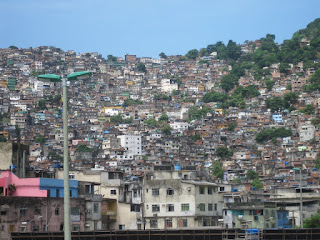
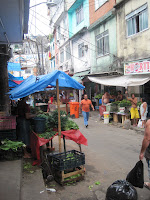
Rocinha, literally meaning “little ranch”, has grown from a community of small farms to the largest favela in Brazil, housing something like 350,000 people. Pharmacies, grocery stores, and butchers (with live chickens) are open 24 hours. Beer costs a buck. Everyone is chillin outside or dodging traffic. Miss a beat in this rhythm of motorcycle traffic, labyrinth stairways, cobwebs of TV and phone cables, blaring music, gritonas, and you’ll definitely get get a toe crushed. After the tranquility of Ipanema, it’s actually kinda nice.
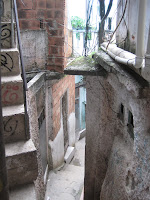
Nildo, my guide, admits that he gets lost sometimes and he’s from here. I found him through Favela Tourism Workshop, a group that trains youth from Rocinha to be tour guides and helps them receive their guide certification from the department of tourism. A better bet than going with a guide from Copacabana and arriving in a jeep with 10 gringos. Nildo is short, a fast-talker (in perfect English), honest but gentle when telling you the ugly truths, and damn good at metaphors.
“You know the horse that just sits and lets flies gather all around him but doesn’t do anything to swat them away?” he said. “Yeah, that’s how the police were when they were here.” Corrupt? Of course. How’s the violence? We see it everyday (although he said City of God was over the top). “But it was never like this when i was a kid,” he said. “It’s changed.”
But on to the positive, because that’s what we don’t hear about. What else is changing in Rocinha?
From the top: At the entrance to the favela there’s a blinding white building being constructed. It’s a community center, part of a government initiative to “clean up” the favelas, along with more motorcycle taxis, a surf school, a hostel for international volunteers, “pacific” police, and a new hospital. Despite cynical attitudes towards government and police, it seems Nildo and others are still excited about the initiative.
From inside the favela:
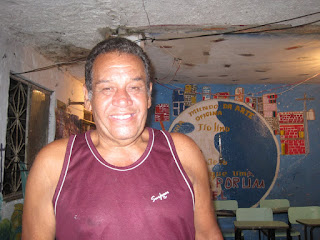
Uncle Lino: His organization, “Trade a gun for a paintbrush” provides kids who are struggling with drug addictions with a safe place to get creative. Uncle Lino, with the help of volunteers, teaches kids to create art projects with recyclable material.
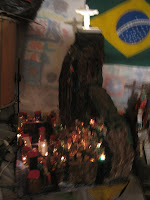
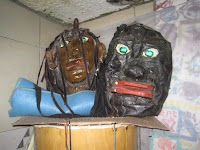
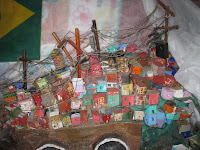
25 of the 50 kids he started working with have gone to college. WOW, write grants much, Ferron? That being said, 50% success rate, you ask the grantwriter? Across the road from the school I saw three boys, no older than 10, blazed out of their minds. One of them was rolling his joint back and forth in a trance. I’d like to see YOU pry it from his hand and replace it with a paintbrush. Despite his tough job, we got some good laughs out of Uncle Lino. Just had to ask him about government assistance.
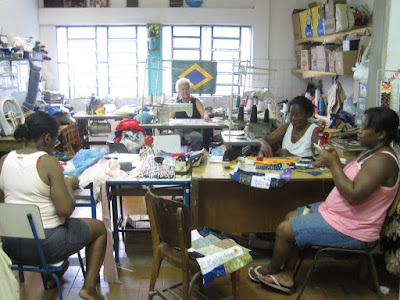
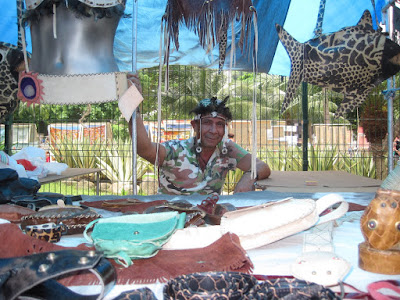
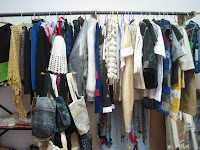 The free kindergarten: Minimum wage in Brazil is about $500/mo. Most kindergartens cost $300/mo per kid. So here’s the only free kindergarten in the neighborhood, built by the government, sustained by a few philanthropists and these women. In 1983 Senhora Teresa (pictured in the middle) started a co-op downstairs where unemployed parents can come to learn a craft (mostly using recycled materials). The purses, clothing, and home decorations are sold in stores in Rio and have been picked up in France and Japan. Proceeds go to the school.
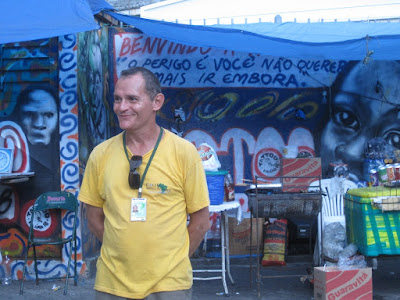
On the way out Nildo takes us through the market and we end up at the bottom of the hill. I asked him to strike a pose here. Behind him reads, ” Welcome to Rocinha. The only danger here is that you will never want to leave.”
Got the travel bug?
Favela tour: http://www.favelatourismworkshop.com/
Nildo aslo does private tours in the evenings: [email protected]